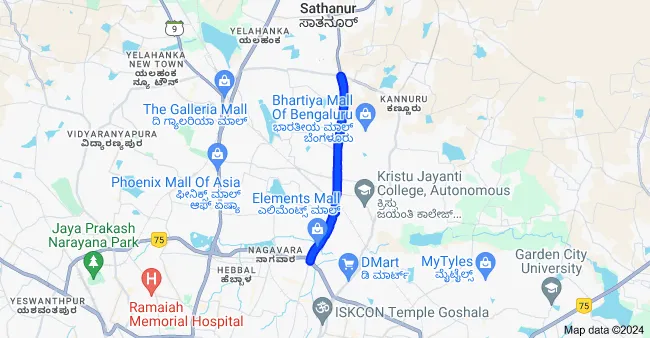
Thanisandra Main Road Widening: Infrastructure Update for 2025–26
Roads matter for residential property value in ways buyers often underestimate. A widened, well-flowing arterial reduces commute times, lowers ambient noise, and generally lifts property values along its length. Conversely, a congested, narrow road imposes a daily quality-of-life cost. Thanisandra Main Road has been one of Bangalore’s busiest residential arterials for years, with traffic volumes that have at times outpaced the road’s design capacity. The ongoing widening of Thanisandra Main Road is one of the more consequential infrastructure stories for the corridor, and for prospective buyers at L&T Thanisandra it is worth understanding.
The story so far
Thanisandra Main Road developed organically as the residential corridor expanded, with the road infrastructure often playing catch-up to development pressure. Traffic volumes during peak hours grew substantially over the 2015–2022 period, driven by Manyata employment, residential build-out, and the road’s role as a primary feeder to the Outer Ring Road and Hebbal.
By the early 2020s, the case for systematic widening and infrastructure upgrades had become difficult to ignore. BBMP and infrastructure agencies have progressively initiated widening, junction improvement, and signalisation projects along the corridor.
What the widening involves
- Carriageway expansion — adding lanes along key stretches of the road to accommodate higher traffic volumes.
- Junction improvements — upgrades at key intersections, including grade-separated solutions where feasible.
- Footpath and pedestrian infrastructure — improving walkability along the corridor.
- Signal modernisation — adaptive signalling to better manage peak-hour flows.
- Drainage upgrades — addressing monsoon flooding that has historically affected the corridor.
Why this matters for Thanisandra residents
- Reduced commute times — better road flow translates directly into faster commutes to Manyata, Hebbal, and beyond.
- Lower noise and air pollution — flowing traffic produces less localised noise and lower vehicle idling emissions than congested traffic.
- Better last-mile access — improved internal road connectivity from main projects to Thanisandra MR.
- Property value support — infrastructure upgrades along arterial roads have historically been positive for adjacent residential values.
Construction phase realities
Infrastructure construction is, almost by definition, disruptive in the short term. During active construction phases, residents and commuters can expect periodic traffic diversions, noise from work zones, and occasional access disruptions. For prospective L&T Thanisandra buyers, the relevant question is whether possession (4–5 years out) will fall within or after the major construction phases. The answer is mostly favourable: by the time construction completes at L&T Thanisandra, the bulk of road widening work should be in advanced or completed phases.
Connection to broader infrastructure
Thanisandra Main Road widening sits within a broader infrastructure programme for North Bangalore that includes:
- Hebbal junction upgrades — flyover capacity and signal modernisation to ease the city’s principal north-corridor bottleneck.
- Pink Line metro extensions — additional stations and frequency improvements along the line.
- Blue Line construction — airport metro construction along Bellary Road and ORR.
- Peripheral Ring Road (planned) — long-planned circumferential connector that will add east–west capacity.
- Civic infrastructure upgrades — water, drainage, and electrical capacity improvements supporting denser residential development.
Together, these projects represent one of the largest concentrated infrastructure investments in any Bangalore corridor over the next 5–10 years. The cumulative effect on commute time and quality of life is likely to be substantial. For more on the metro components, see Pink Line: North–South Bangalore Connectivity and Bangalore Airport Blue Line 2027.
Property value implications
Properties along corridors undergoing infrastructure upgrades typically experience a two-phase value pattern: some short-term disruption during active construction (typically affecting rental rates more than capital values), followed by structural value uplift once the upgrades are operational. For long-horizon buyers, this is generally a net positive — particularly when entry happens during the disruption phase, where prices may be slightly suppressed before the post-completion uplift.
How to track progress
- BBMP announcements — official updates on widening project phases and completion targets.
- Local news coverage — North Bangalore real estate and civic publications cover progress.
- Site observation — visible construction activity along the corridor is the most direct indicator of phase progress.
- Resident feedback — current residents of the corridor provide real-time perspective on construction realities.
For overall location context, see our Location page. For project details, the Home page. To register interest, contact us.