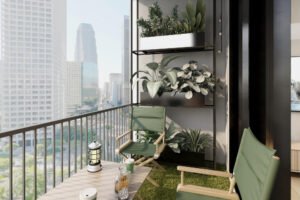
Staggered Balcony Design & Privacy in High-Rise Apartments
In high-rise residential buildings, balcony design is one of the more architecturally consequential choices that affects residents’ daily privacy and quality of life. Get it wrong and you have buildings where balconies face directly into other balconies, where conversations carry across the void, and where step-out moments require checking who is watching from across the way. Get it right — through staggered orientation, considered setbacks, or angled placement — and balconies become genuinely private extensions of indoor living. At L&T Thanisandra, balcony design is expected to follow the considered approach that L&T Realty applies across its premium portfolio.
The privacy problem in high-rise design
Standard high-rise residential design often suffers from a basic privacy challenge: when towers are placed close to each other, balconies of one tower face directly into balconies of the next. Sightlines are direct, sound carries across the void, and residents can see — and be seen by — neighbours during routine balcony use. For premium projects, this kind of mutual visibility is unacceptable. The architectural solution requires deliberate planning.
How staggered balcony design works
Several architectural strategies address the privacy challenge:
- Staggered placement — balconies on adjacent floors are placed at different points along the facade, breaking direct vertical sightlines.
- Angled orientation — balconies are angled rather than perpendicular to the facade, redirecting sightlines away from neighbouring balconies.
- Privacy screens and louvres — vertical or horizontal screening elements break direct visual access while preserving views.
- Tower setbacks — generous setbacks between towers reduce the relevance of inter-tower visibility.
- Landscape buffering — vegetation and tree planting create visual softening between towers.
- Recessed balconies — partial recessing into the building envelope provides side-screening.
L&T Thanisandra’s expected approach
L&T Thanisandra’s master planning is expected to incorporate considered balcony design that prioritises privacy. The 12-acre footprint and 8-tower configuration provide the spatial flexibility for tower placement that minimises balcony-to-balcony visual conflict. Lake-facing towers, in particular, are oriented toward the open lake rather than toward each other, eliminating the inter-tower visibility issue for the project’s most premium inventory.
Why balcony privacy matters
- Daily comfort — being able to step out for morning coffee, evening tea, or a phone call without checking who is watching.
- Sound privacy — open conversations not carrying across to neighbours’ balconies.
- Aesthetic enjoyment — appreciating views, plants, or balcony decoration without visual interference from across the void.
- Security feeling — particularly for ground-level facing balconies, sense of personal security in semi-private space.
- Functional use — balconies designed for genuine use as outdoor extensions rather than just decorative ledges.
Balcony design and lake views
For lake-facing units at L&T Thanisandra, balcony design takes on additional importance. Generous, deep balconies oriented toward Chokkanahalli Lake are expected to be a defining feature of the premium inventory. These balconies serve dual functions: they extend living space outdoors during pleasant weather, and they frame the lake view that is one of the project’s primary differentiators.
Indoor-outdoor flow
Modern luxury residential design increasingly emphasises indoor-outdoor flow — the seamless transition from living spaces to balconies that allows residents to use both as continuous living environments. Key elements include:
- Large sliding doors — UPVC or aluminium-framed sliding glass doors connecting living rooms to balconies.
- Level transitions — minimal level differences between indoor and balcony floors, supporting comfortable movement.
- Material continuity — flooring transitions that blur the indoor-outdoor distinction.
- Functional sizing — balconies sized to accommodate seating, plants, and casual entertaining.
- Weather protection — partial cover or recessed design protecting balcony use during light rain or harsh sun.
How to evaluate balcony design at site visit
- Inter-tower sightlines — at site visits, look across at neighbouring towers and assess whether their balconies face yours directly.
- Floor-to-floor sightlines — assess whether you can see directly into balconies above and below from your floor.
- Balcony depth — assess whether balconies are sized for genuine use (typically 5+ feet deep) or just decorative narrow ledges.
- Privacy elements — observe whether screening, landscape, or design strategies provide privacy.
- Sound transmission — at the site, assess how much sound carries from one balcony to another.
Verdict
Balcony privacy is the kind of architectural detail that buyers often only appreciate after they have lived with bad design. The right approach during planning — staggered placement, angled orientation, generous setbacks, considered screening — delivers daily quality-of-life benefits that compound over years of residence. L&T Thanisandra’s master planning approach is expected to deliver this kind of considered balcony design, with the lake-facing orientation eliminating the inter-tower visibility issue for premium inventory.
For broader architectural context, see Low-Density High-Rise Living: Why Fewer Units Per Floor Matters. For specifications, Specifications page. For project details, the Home page.