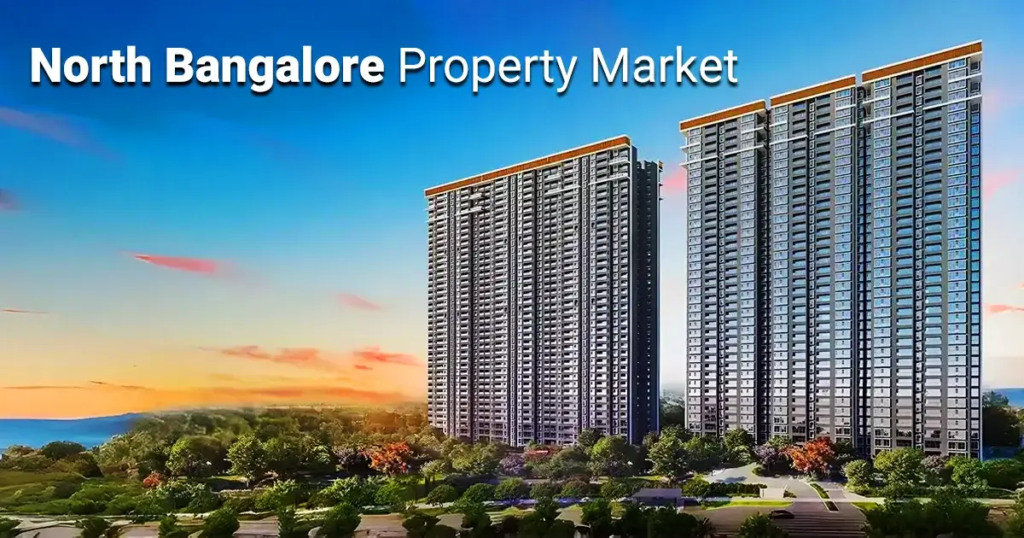
North Bangalore Real Estate Forecast 2025–2030
Forecasting real estate is, candidly, an exercise that requires humility. Markets move on a complex mix of macroeconomic conditions, infrastructure timelines, employment shifts, and buyer sentiment — none of which can be predicted with precision. What can be done usefully is mapping out the structural factors that are reasonably visible today and reasoning about how they are likely to interact over a 5-year horizon. For North Bangalore over 2025–2030, the visible structural factors all point in the same broad direction. Here is the case.
The starting position in 2025
North Bangalore enters 2025 as one of the city’s two strongest residential corridors (alongside the eastern ORR–Whitefield belt). The corridor is anchored by Manyata Tech Park, the airport, Hebbal as a transit junction, and a deepening base of premium residential supply. Property values across the corridor have grown meaningfully over the past 5 years, but premium pricing still sits below the highest-priced corridors in the city — leaving room for both end-user demand and investment growth.
Five structural drivers for 2025–2030
- Blue Line metro operationalisation — targeted around 2027. When operational, this transforms airport accessibility from the entire Hebbal–Thanisandra–Yelahanka belt and creates a meaningful price catalyst.
- Continued IT and technology employment growth — Manyata, Kirloskar Business Park, and the broader corridor employment base continue to expand. India’s overall IT services sector remains a structural growth driver.
- Infrastructure pipeline — Thanisandra Main Road widening, Hebbal junction upgrades, Peripheral Ring Road, and other projects continue to roll out.
- NRI investment depth — North Bangalore continues to be a primary destination for NRI residential investment given airport access and quality developer presence.
- Premium supply maturation — credible developers (L&T, Sobha, Prestige, Puravankara, Bhartiya, and others) continue to deliver and launch in the corridor, supporting brand premium and resale liquidity.
Indicative price trajectory scenarios
Three plausible scenarios for premium new-launch pricing in the Thanisandra–Hebbal corridor over 2025–2030:
| Scenario | Conditions | Indicative 2030 Premium ₹/sft |
| Baseline (most likely) | Steady IT growth, Blue Line operational by 2028, no major macro shocks | ₹17,000–20,000 |
| Bull case | Strong IT growth, Blue Line on time 2027, accelerated infrastructure, low rate environment | ₹19,000–23,000 |
| Bear case | IT slowdown, Blue Line delayed to 2029+, macroeconomic headwinds | ₹15,000–17,000 |
(Figures are indicative scenarios based on extrapolation of current trends. Not investment advice.)
Yield trajectory
Rental yields are likely to compress modestly over the period as capital values rise faster than rents — a pattern typical of maturing corridors. From current 3–4% premium-segment yields, expect 2.8–3.5% by 2030. This is still attractive in absolute terms but lower than current entry yields.
Within the corridor: where to invest
Even in a constructive corridor outlook, specific micro-locations and projects perform differently. Factors that should support outperformance over the period:
- Lake-facing positions — supply constraint on lake-adjacent inventory is structural; this should support relative outperformance.
- Metro-adjacent locations — 4 km radius of Pink Line stations and future Blue Line stations should outperform metro-distant locations.
- Branded developer projects — L&T, Sobha, Prestige, and other premium developers should support brand premium.
- Mature catchments — corridors with established schools, hospitals, and retail should sustain better than locations awaiting catchment maturation.
L&T Thanisandra checks each of these boxes — lake-facing, near both Pink Line and future Blue Line, premium L&T brand, mature catchment. This positioning is unusually well-aligned with the structural drivers expected over 2025–2030.
Risks to the forecast
- Macro slowdown — sustained Indian economic slowdown would compress premium real estate demand.
- Interest rate environment — sustained high rates affect home loan affordability and investor demand.
- Infrastructure delays — Blue Line slippage beyond 2028 would defer one of the strongest catalysts.
- IT sector restructuring — major shifts in the Indian IT employment landscape would affect Manyata-anchored demand.
Conclusion
The structural drivers for North Bangalore real estate over 2025–2030 are predominantly favourable. The combination of metro expansion, continued IT employment growth, infrastructure investment, and limited premium supply pipeline supports a constructive outlook. Within the corridor, projects with lake-facing positions, branded developers, and pre-launch entry pricing are particularly well-positioned. L&T Thanisandra captures all three.
For corridor history, see Thanisandra Property Appreciation: 5-Year Analysis. For yield analysis, see Strong Rental Yield Near Manyata. To explore the project, Home page.